Star Wars: Revenge of the Sith
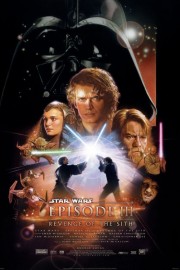
Spoilers Alert. If you want to go into “Episode III” knowing as little as possible (if that’s possible), best to leave this unread until you see the film.
“The circle is now complete.”; Darth Vader, “A New Hope”
28 years ago, George Lucas released what he’d hoped was the first in a trilogy of science-fiction adventures with “Star Wars.” Everything pointed to disaster. What happened is a phenomenon the likes of which we’ll never see again in cinema, as a beloved franchise arose, the artistic focus of studios at a time of tremendous creative flux changed forever, and a new paradigm in moviemaking- both artistically and financially- was achieved. This year, the whole story can now be told, and the franchise which has grossed over 3 billion worldwide can be viewed in its entirety, with no storytelling rock unturned and no revelations left to tell (on the bigscreen at least; further TV projects are being developed). This will be a review both objective and subjective about “Sith” and the series as a whole, and will look at how “Sith” changes the focus of the original trilogy and brings focus to the first two prequels, which to many, left much to be desired.
“Laugh it up, fuzzball.”; Han Solo, “The Empire Strikes Back”
If you find yourself busting a gut in “Sith’s” first few minutes, don’t be alarmed. Despite being- as advertised- the darkest of the “Star Wars” films (yes, even darker than “The Empire Strikes Back”), George Lucas gets the ball rolling with a pitch-perfect blend of dramatic action and subtle comedy as Jedi Knights Obi-Wan Kenobi (Ewan McGregor, who has matured gracefully into the role over the course of the prequels and is sensational in this film) and Anakin Skywalker (Hayden Christiansen, underrated in “Episode II,” delivering the dark goods here with surprising gravitas) attempt to rescue Chancellor Palpatine (Ian McDiarmid) from the clutches of Count Dooku (Christopher Lee, in a pivotal but brief cameo at the start) and General Grevious, the vicious multi-light-saber-wielding half machine/half-monster fans were introduced to in the brilliantly-crafted animated micro-series “Clone Wars,” which- for many fans (including myself)- was even better than “The Phantom Menace” and “Attack of the Clones” at being a sly and exciting “Star Wars” adventure like the ones in the original trilogy. Don’t expect “Men in Black” or “Galaxy Quest” like high jinks, though; it’s still a “Star Wars” movie, with Obi-Wan and Anakin facing hair-raising obstacles to make their way to where Palpatine is being held on Grevious’s ship (which they’ll have to safely guide to a crash landing later), while R2-D2 (more than just Kenny Baker now, he’s a CG character in a lot of scenes) is forced to balance his duties in helping Anakin and Obi-Wan while also keeping himself safe. Not an easy thing for the astro-droid to do, the results sometimes along the lines of a silent comedian like Buster Keaton- plucky, determined, funny, resourceful, sometimes frustrated- and reason enough for audience applause. This is a return of the R2 we know and love, not that he ever really went away (he’s got a great moment in “Menace” when he’s first introduced), but his resourcefulness brings to mind more the original trilogy (and “Empire” in particular) than his obvious tactics in “Clones,” which are more cliche. As always, leave it to R2-D2 and his protocol droid counterpart C-3PO (the great Anthony Daniels, the only actor to not only appear in all six “Star Wars” films- a distinction he shares with Baker- but also lend his voice to the essential “Clone Wars” series as well) to add levity to the drama going on around them, including a reaction by 3PO about his fate that might seem out of place given the weight of what’s happening around them, but is altogether hilarious in its own right. I think I’ll miss them most of all.
(By the way, to discover the origins of these characters from a writing standpoint, I highly recommend Akira Kurosawa’s “The Hidden Fortress,” about two comic companions watching a battle unfold around them during the age of samurais in Japan. This was Lucas’s acknowledged inspiration for his beloved droid friends, and though I haven’t seen the entire film yet (the DVD I was watching screwed up in my player about halfway into it), it’s a great entertainment from a master.)
“So this is how liberty dies…with thunderous applause.”; Padme Amidala, “Revenge of the Sith”
Much has already been made about the eerie parallels between the events in “Sith,” and the current political climate in the United States, both of which are lead by individuals whom many- though not the majority apparently, given the results of November’s election- feel have overstayed their term of office (G.W. Bush, “Star Wars’s” Senator Palpatine), both of which are embroiled in a war built on a lie many feel didn’t need to be fought (the War in Iraq, “Star Wars'” Clone Wars). For me, I’ll save my own feelings on those parallels- which are obvious, though done with subtlety and intelligence- for another time (namely, a Yahoos With a Microphone commentary); for now, I’ll leave those arguments to the political and social commentators in the news media more knowledgeable than myself on political matters, if not “Star Wars,” who’ll surely twist the meaning to their own agenda as they tend to do. Well, I will say this…
…here’s why I believe George Lucas when he says he wasn’t out to make an allegory about modern times in this final “Star Wars” film- because he so finely laid the groundwork for what we see here- and have been seeing on a political front in the prequels- back in 1977’s “A New Hope.” Think about it- in “Hope,” the Jedi are long decimated, Emperor Palpatine (I’m not giving anything away here, right?) dissolves the Senate, and the Rebel Alliance (the beginnings of which are shown here as it’s created by Senator Bail Organa (Jimmy Smits), who’ll later adopt Leia; the role Padme Amidala (Natalie Portman) has in the formation of the Rebellion is rumored to be a deleted scene on the forthcoming DVD) is continuing to fight against the Empire. This is stuff we knew coming in. What we came to the prequels to find out- at least I did- were the “hows” and “whys.” Now, if that’s somehow paralleled with what’s going on in the world- and I’m not pretending it doesn’t- call it coincidence, and keep in mind the fact that most movies- including the original trilogy- are inevitably reflections of the times that they were made. Lucas has had this story in his head for about 30 years (maybe not the details, but the general outline, as he’s stated in the past); if any modern thinking has made its way into it, we shouldn’t be shocked.
(All that said, it is still very much a movie of the time which it was made, and one exchange seems ripped directly from this time in the world. When Anakin is telling Obi-Wan- before their fateful battle on the lava planet of Mustafar- how he has brought peace to the former Republic/now Empire, he tells Obi-Wan, “If you’re not with me, then you’re my enemy,” to which Obi-Wan replies, “Only a Sith deals in absolutes.” It’s impossible to deny that this dialogue isn’t a reflection on the current political climate we find ourselves in.)
Now, all the political upheaval that’s been going on in the galaxy in the prequel trilogy has been a bitter pill for fans of the series expecting movies more like the action-adventures (with a little character and plot to go a long way) of the original trilogy- “A New Hope,” 1980’s “The Empire Strikes Back,” and 1983’s “Return of the Jedi”- than what we’ve gotten with the creatively-underwhelming (in many opinions, not my own) prequels. I for one have been intrigued by it- it’s unusual for the genre, and in the way it’s written to play out makes for some fascinating and unorthodox touches. Who knew we would get a “Star Wars” political thriller, and- if you’re interested in those types of story- who knew it would make such interesting viewing (“Clones” was most interesting on this front). I love that all the while Palpatine is manipulating the main characters- Padme, the Jedi, the Senate- through their passions and feelings to where he grows more powerful politically as Chancellor Palpatine, and as his alter ego- Sith Lord Darth Sideous- orchestrating the mass secession of systems- and the start of the Galactic Empire- that will lead the galaxy into the Clone Wars, a conflict he prolongs through his control of one side (as Sideous), while occasionally feeding information- both accurate and false- to the other side (as Palpatine), all in the pursuit of his eventual end-game- wiping out the Jedi Order, leaving the Sith- and himself- to run an oppressive dictatorship with those who would oppose him with no warriors powerful enough to dethrone him. Of course, all this would be terrifically drab to follow were it not for the subtlety seductive and menacing performance by McDiarmid, 38 when he first appeared in “Jedi” as the Emperor, who gives a memorably intelligent and devious performance- in the most important role to have work- in “Episode III” as we finally get to the dark soul of the character, and see what made him and his thinking so tantalizing for Anakin. If this “Phantom Menace” was not so multi-layered as McDiarmid and Lucas make him here, the prequel trilogy- and “Sith” especially- would have failed. And if he had been too obvious in his maneuvering- to the Jedi, to the Senate- audiences wouldn’t have believed his success in destroying the Republic. Well played Ian and George. Well played.
“If you strike me down, I shall become more powerful than you could possibly imagine.”; Obi-Wan Kenobi, “A New Hope”
The above quote is not only my favorite of any in the “Star Wars” lexicon- as I’ve had many instances where I’ve had to remind myself of the idea it embodies- but also is a good description of George Lucas, who- after taking harsh critical and fan beatings for “Episode I,” “Episode II,” and his controversial “Special Editions” of the original trilogy (I no longer have hope we’ll see the original version of the trilogy on DVD)- comes back with a visionary powerhouse that stands just below the series’s best films, Lucas’s own “A New Hope” and Irvin Kershner’s “The Empire Strikes Back”” (which is indeed the series’s best, but “A New Hope’s” a better example of pure popcorn fodder). Some early reviews have hinted that “Menace” and “Clones” were unnecessary- I disagree. Seeing where Anakin came from, seeing his relationship with Padme develop, watching Obi-Wan grow into the powerful Jedi Knight we expect of him through the guidance of Qui-Gon Jin (Liam Neeson from “Episode I”) and Yoda (voiced by Frank Oz), seeing the surprising origins of both R2-D2 and C-3PO, the start of the Clone Wars, seeing the gradual fall of the Republic, even Jar Jar Binks (who appears in the corners in “Sith,” but says nothing after being given the most critical plot point of “Clones”), is essential. All of this backstory just couldn’t be condensed well enough into a prologue to “Sith” to be satisfying to fans. That’s not to say all of this couldn’t have been skillfully condensed into one film- leaving the middle part of the prequel trilogy to the material covered in the animated “Clone Wars”- but that’s not how Lucas chose to tell the story. And to know the whole story, you must slog through everything wrong with “Menace” and “Clones”- namely, Jake Lloyd as kid Anakin, the almost “coincidental” victory against the Trade Federation in “Menace” (for more on this, hear the Yahoo’s “Menace” commentary on the film), Lucas’s tin-eared dialogue (especially bad in “Menace,” though some of the love story dialogue in “Clones” is equally wretched), John Williams’s butchered score the last 45 minutes of “Clones”- no matter how unbearable it might be (just MSTie your way through the bad parts like I do). It is how it is- deal with it. As a critic, I can bitch and moan about “Sith’s” flaws, including some of the overly bland dialogue (which is mostly serviceable, but hardly as memorable as the original trilogy’s), the bad makeup job on Chancellor Palpatine when he truly becomes Darth Sideous, and Darth Vader’s last word in the movie, (which I’ll spare you, except to say the scene- which is really good up to that point, and should have been rewritten instead of carried out the way it is- has been done to death as parody on “The Simpsons” over the years). As a fan, though, the story- as it was in “Menace” and “Clones”- is just too damn fascinating to let the criticisms dull my excitement over “Sith.”
“Revenge of the Sith”- featuring (as all the “Star Wars” films do) the finest visual and audio artistry and visionary imagination of the folks at Industrial Light & Magic and Skywalker Sound (special props to sound designer Ben Burtt, visual effects supervisor for the prequels John Knoll, and all-time visual effects extraordinaire Dennis Muren)- did make me realize one big problem with both “Phantom Menace” and “Attack of the Clones,” however, that cannot be ignored by “Star Wars” geeks. In the original trilogy myself and many like me grew up with, “A Long Time Ago, in a Galaxy Far, Far Away…” meant something. You felt as though you were watching something epic and mythic take place, with characters taking part in larger destinies and going through adventures, experiences, and emotions that would change them- and the Galaxy- forever. Watching “Menace” and “Clones,” and then as I was watching “Sith” for the first time, it occurred to me that in the first two movies of Lucas’s prequel trilogy, that mythic sense of destiny you felt in the earlier films was all but gone, save for a few moments here or there (Anakin and Padme’s kiss before being taken into the arena of “Clones,” Obi-Wan and Qui-Gon’s duel with Darth Maul in “Menace,” Anakin’s come-from-behind victory at the Podrace in “Menace,” the beginning of the Clone Wars at the end of “Clones,” and the images of Qui-Gon’s funeral in “Menace” and Anakin and Padme’s marriage in “Clones” all mustered that sense of the epic for me).
But watching “Sith,” every significant event, every battle, every little moment that ties together the saga has that weight the original trilogy carried, despite our already knowing the outcome ahead of time if you’ve watched the original three. (You better have- I’m assuming as much in this review, and also that you watched “Menace” and “Clones” as well.) The opening space battle where Obi-Wan and Anakin are rescuing the Chancellor has the heroic excitement of the dogfights in “A New Hope” and “Return of the Jedi.” The revelation by Padme to Anakin that she’s pregnant doesn’t go as far as Darth Vader’s revelation of parentage to Luke in “Empire,” but it still presents an uneasy reality to Anakin that’s palpable. Palpatine’s discussions of the Dark Side to Anakin, the best being at an opera house that reveals hints of Anakin’s true origins, and the way Palpatine seduces Anakin to the Dark Side by playing on his fears, emotions, and confusion about everything from the Jedi Council (who want Anakin to spy on Palpatine) to Padme (Anakin dreams of her dying in childbirth). Obi-Wan’s battle with General Grievous, which was a disappointment given what we saw of Grievous in “Clone Wars” (his multi-light-sabers are here, but where’s him using his feet in battle as well as his arms?), but still exciting in a way some battles in the earlier prequels weren’t (plus, it has a greatly-satisfying conclusion). A great silent scene between Anakin and Padme, hinting at a deeper emotional connection better than any other scene in the prequels, as the two lovers seem to look at each other across the skies of Coruscant, and Anakin seals his destiny. The Jedi Council- led by Master Mace Windu (the great Samuel L. Jackson- who indeed does not go out like a punk- never has felt unchained as Yoda’s right hand man, but his perpetual cool has come through in “Clones” and “Sith”)- going to arrest Palpatine when it is discovered he is a Sith Lord…and losing more than just the ensuing light-saber battle. The execution of Order 66 (some of Lucas’s finest directing ever in its quiet devastation), Anakin’s part in it (he marches- with Clone Trooper backup- on the Jedi Temple), the assassination attempts on Yoda (who escapes with the help of an old friend from the original trilogy) and Obi-Wan, and Padme’s reaction to the Temple in flames. Anakin’s discussion with Padme when he returns from the Temple, telling the truth but keeping the real truth from her. Yoda and Obi-Wan at the Jedi Temple, and all that happens after (which I’ll go further into below). It’s harder- though not impossible- to think of a scene in “Sith” that doesn’t feel epic than one that is, because so many do.
“You were the Chosen One!”; Obi-Wan Kenobi, “Revenge of the Sith”
In “The Phantom Menace,” the Jedi speak of a prophecy that tells of one that will bring Balance to the Force. It is assumed that Anakin- who has the highest concentration of midichlorians (biological life forms that work in symbiance with the Force) of any Jedi- is “The Chosen One,” the one who will destroy the Sith and bring Balance.
But as Yoda says, “A prophecy that misread might have been.” The more one thinks of the prophecy (which is not unlike one in the show “Angel,” which has a vampire with a soul playing a major role in the apocalypse, but which side he’s on is unclear), the more one thinks of the nature of the Force. To be put into Balance, it must be out of Balance to begin with. There are many different ways of looking at it. In the prequels, it seems as though the Good Side of the Force has the upper hand, with the Sith and the Dark Side all but extinct. If you look at it this way, that would mean the power of the Dark Side would have to grow- as it does in “Sith”- in order to bring Balance, and that by turning to the Dark Side, Anakin is restoring Balance to the Force and fulfilling the prophecy, just not in the way the Jedi think, implying that the prophecy was indeed misread.
But there’s a catch to that theory, and that is the destruction of the Jedi that we see in “Sith.” The Dark Side takes over, and wants to eliminate the Good Side forever, and almost succeed (by film’s end, only Yoda and Obi-Wan are left). But if you think about it, the Dark Side already tipped the scales when Palpatine became Supreme Chancellor, because in “Clones,” the Dark Side was clouding the abilities of the Jedi, and by turning to the Dark Side, Anakin has tipped the scale further. But in the grand scheme of the “Star Wars” saga, we realize we already saw fulfillment of the Jedi’s prophecy back in 1983 in “Jedi,” when Anakin is redeemed by Luke and overthrows the Emperor. This is where a deeper exploration of the story in Lucas’s epic is necessary to understand it fully. Now doesn’t it all make sense? (No funny comments to the contrary you fanboy wiseasses out there.)
“Battle of the Heroes”; Title of “Sith’s” main musical theme, written by John Williams
“Revenge of the Sith” does many things that turns the entire “Star Wars” Saga on its ear, not the least of which is that it confirms simply what George Lucas has been saying since at least the 1995 final release of the original versions of the original trilogy, in that the saga is about Anakin’s rise, fall, and redemption. I would also argue that it not only shifts the focus of what the saga is about, but also who it’s main heroes and villains are. “Sith” makes clear that Anakin- though the focus of the story- is a pawn for both the Jedi and the Sith to play with to get what each of them want- the Jedi want him to spy on Palpatine to uncover the mysteries around him, and Palpatine wants him to spy on the Jedi, all the while filling his head with ideas that will eventually prove to be the Jedi’s undoing.
The villain of the “Star Wars” Saga- as we contemplate the entire sextet- is clearly Palpatine- he’s manipulated the story from “Episode I” and is the supreme ruler of the galaxy through the original trilogy when he dissolves the senate in “Episode IV” and manipulates the final attack by the rebels in “Episode VI.” Though Darth Vader is clearly the heavy in “A New Hope” and “The Empire Strikes Back,” we see in “Sith”- and later in “Return of the Jedi”- that he is only the second in command of the empire to the Emperor. And though he believes that he is more powerful than Palpatine in “Sith”- when he tries to persuade Padme to join him in ruling the galaxy (as he does with Luke in “Empire”)- his confidence is lost when Obi-Wan makes him limbless at the end of their duel, and leaves him for the lava of Mustafar (hence the freaking breathing suit). He is not all-powerful. His arrogance in his abilities put himself in the place of lackey to Palpatine. Only in his last moments in “Jedi”- with the Emperor killing his son- does he truly have the strength to overthrow Palpatine. So in one moment, he goes from second-in-command of evil to his proper place on the side of good.
But “Sith” also does something else, I think, in that it establishes the heroes for the series as Obi-Wan and Yoda. It sounds odd, but think about it. In “Menace” and “Clones,” we’ve seen both iconic figures do heroic acts as the galaxy’s democracy has gone into decay- Obi-Wan vs. Darth Maul in “Menace,” Yoda leading the Clones in “Episode II”- and, though Obi-Wan has progressed from Padawan to Jedi Knight before our eyes, it is clear he is one of the leading generals of the army against the Separatists in the Clone Wars. And though it is against the better judgment of the Council, he is put in charge of Anakin’s training, and though you feel a sense of guilt on his part, as if he failed Anakin in the original trilogy, we can see it was Palpatine’s feeding of Anakin’s hubris- and the bureaucratic Council’s inherent distrust in his abilities- that lead to his downfall, not any lacking in Obi-Wan’s teachings.
The “Clone Wars” cartoon series confirms that as we see the bond form between the two, which makes their long-awaited battle on Mustafar all the more difficult to watch. Friends pitted each other by destiny and disloyalty- on both sides- and Williams’s “Battle of the Heroes”- which plays during the scene- cuts right to the heart of that conflict as Obi-Wan and Yoda- the only other remaining Jedi- battle Anakin and Palpatine in a last attempt to eliminate Palpatine once and for all. But during the scene, was I the only one who felt it was always more of a symbolic fight than anything? I mean, if you’ve seen the original trilogy, you know they don’t win, but what engages you more- I think- is just the fact that they fight anyway. It’s an inspiring imagine that makes the outcome tough to take, but a necessary one to see that there is still hope for the galaxy. I mean, do you sense Yoda realizes their battles will be futile, and that it is just one last defiant swing before they go to fight another day? Maybe this comes just from the knowledge that yes, in the end, good will triumph, and in their teaching of Luke, Obi-Wan and Yoda will achieve ultimate victory in their struggle, but it’s certainly one thing that popped into my head thinking about the movie.
“She was…very beautiful. Kind, but, sad.”; Princess Leia, “Return of the Jedi”
The above quote comes in what is one of the most memorable scenes of “Jedi,” marred in many people’s eyes by Ewoks (I was 5 1/2 when I first saw it, so I’ve always liked the furry guys), and is one of the most lasting images of the original trilogy, as brother and sister are brought together for the first time with that knowledge as Luke- who has no memory of his mother- asks Leia off her memories. One of the most intriguing elements going into the prequels was going to be the characterization and realization of this visual image we’d been seeing for the first time. Enter Natalie Portman. From her debut in Luc Besson’s brilliant thriller “Leon: The Professional,” Portman- in films as diverse as “Beautiful Girl,” “Everyone Says I Love You,” “Heat,” “Cold Mountain,” “Garden State,” and her Oscar-nominated performance in “Closer”- displayed a level of intelligence and emotion beyond her years that’s made her the best actress of her generation, and a natural for the role of Padme Amidala, the Queen-turned-Senator (echoes of Hilary Clinton anyone?) who- against her better judgment- falls in love with the much-younger (and less worldly) Anakin.
In “Menace” and “Clones,” you see in Padme both Luke’s idealism and Leia’s strength as a leader and fighter as she is caught up in a silent war against the galaxy’s democratic system that will eventually lead to the darkness that “Sith” concludes in. In both films, Portman brought the same spirit Carrie Fisher invested in Leia to Padme in performances that recalled her work in “The Professional” and paved the way- if you think about it- to her sensational turn as a mother who has to fend off some ruffians in “Cold Mountain” and the freedom fighter she plays in the current “V for Vendetta.”
In “Sith,” she is already pregnant with Luke and Leia. Her role in this film is that of the grieving widow in a way, a woman once idealistic about not just the work she was doing for the greater good, seeing it shattered by betrayal and real life. The scene that says this better than any other is the one leading to the film’s emotional climax where Obi-Wan- her old friend- must deliver the news of her secret husband’s turning to the Dark Side to a woman masking her heartbreak in denial. The dialogue and delivery feels stilted at times (remember, this is Lucas writing and directing), but when Obi-Wan says what he must do- and what it means to her- without really saying it, Portman and McGregor remind us why they were so perfect for their roles in this trilogy in the first place. At this moment, Portman becomes the physical embodiment of that indelible description from “Jedi,” and brings it to life.
“I kept thinking how much better ‘Sith’ would play as a silent film, with only Chewbacca allowed to do his Wookie growl and John Williams to trumpet his recycled score.”; Excerpt from Peter Travers’s “Sith” review for Rolling Stone
The above quote is par for the course in terms of what I expect from Travers on Williams. To be fair, he- like longtime friend/collaborator Steven Spielberg- is an easy target; when you’re one of the most successful people in your field (both financially and critically- Williams has five Oscars), it’s sometimes easy for critics to be blase when it comes to your actual talent. That’s when you need to read the people whose writing and passion for the medium is focused on that area- at places like Film Score Monthly…or you just go to the geeks. Thankfully, you happen to be reading one whose passion for film music is absolute.
In some cases, Travers’s criticism of a Williams’s score as “recycled” would make sense (I’m looking at you, “Harry Potter and the Chamber of Secrets”), but given that Williams is writing what is fundamentally the sixth movement of his 12-hour “Star Wars” symphony, you can forgive him a little bit of revisiting of the old themes (especially since he’s being asked to finish his opus in the middle). Where the untrained ear hears recycling, the trained ear hears creativity and inspiration.
In the case of “Sith,” all one needs to turn to is the Force theme. This is the noble, powerful lietmotif associated with Obi-Wan Kenobi and his teaching of the ways of the Force in the first “Star Wars” film back in 1977. And for 25 years through five films, its development by Williams has remained dramatic in this way. But in “Sith,” Williams reinvents it fully as a heroes theme. Its association remains with Obi-Wan (the hero of “Sith”), but its performances are more like triumphant fanfares than contemplative dirges for an era of heroics gone by. Listen to its performance at four moments in the film- at the beginning, when Obi-Wan and Anakin are flying to rescue Palpatine; as Obi-Wan leaves Courescant to the planet where General Greivous reportedly is, and again when he arrives there; and finally, as Yoda and Obi-Wan are fighting their way into the Jedi Temple after Anakin’s turn and Palpatine’s assassination order against the Jedi. All four moments gave me goosebumps and a jolt of exhilaration watching the movie for the first time, and all four point to the idea that it doesn’t take a great composer to write a great musical theme, but it does take one to break it down, explore its possibilities, and re-imagine it for the given situation. “Sith” wasn’t the first time Williams used the theme this way (who could forget the Throne Room cue at the end of “A New Hope?”…it was just my favorite.)
It’s interesting how Williams’s work through the six films- and the prequels in particular- has progressed musically. While “Hope” and “Empire” were more classic symphonic orchestral works, starting with “Jedi” and moving through the prequels, one charts a gradual expansion of the ensemble while maintaining a musical continuity that remains very much “Star Wars.” The ensemble has expanded through the use of a choir and percussion to punch up the still-dominant strings and winds. “Sith” has some of the best uses of both. The percussion helps propel the action cues at the beginning of the film and as Obi-Wan and General Grievous fight it out (he’s had a particular fondness for the marimba, vibraphone, and xylophone since “Menace”). The choir is used in different ways. Mournful moments like the extermination of the Jedi call for a more funereal tone similar to his heartbreaking score for “Schindler’s List.” Sinister moments such as Palpatine’s teaching of Anakin during the opera- one of the film’s best scenes- brings to mind the dark choral textures in “Jedi.” And as Obi-Wan and Yoda go on the offensive to try and dethrone Palpatine and Anakin, the epic choral work of the score’s centerpiece- “Battle of the Heroes”- brings to mind the similar effect of “Menace’s” “Duel of the Fates,” only on a more dramatic and personal level; again, that mythic grandeur is back in the series, and after a bitter result from “Attack of the Clones” (which I mentioned), fans finally got to hear- once again- what can happen when you put your full faith in a master composer. In a landmark year for Williams (who delivered four spectacular scores), would it be surprising for me to say his score for “Sith” was the most rewarding as a fan?
“A New Hope”; Subtitle, the original “Star Wars” in 1977
“Revenge of the Sith” ends the “Star Wars” saga- and prequel trilogy- shrouded in the darkness of evil triumphing over good. But as long-time fans know, it won’t always be this way. A pair of children are born whose different paths will converge, and they will together- but separately- take journeys of exciting adventures and spiritual growth that will lead to a restoration of balance throughout the galaxy, and the redemption of a father they’ve only known as a man of evil. As their mother dies- and father rises as Lord Vader- she says to Obi-Wan, with her last breath, “There’s good in him. I know…I know it…still.” Despite a broken heart, Padme is ever idealistic about the future, and that glimmer of hope resonates as we see the destinies of characters- who will play significant parts in the rebuilding of the galaxy in the classic movies of the saga- in final moments that are truly worthy of the word “epic.” In a way, “Sith” reaffirms that idea of “A New Hope” when one considers it’s creator. George Lucas started the “Star Wars” saga hailed as a visionary, only to be derided as he began to finish his epic story as critics complimented the visual wonders of his new trilogy but criticized his out-of-practice writing and directing skills. With “Sith,” Lucas finally finds the balance of the two that made people fall in love with “Star Wars” in the first place.
The “Star Wars” Saga on Film- The Grades:
1. “Star Wars: Episode IV- A New Hope” (1977)- A+ #10 Best Film of All-Time
2. “Star Wars: Episode V- The Empire Strikes Back” (1980)- A+ #44 Best Film of All-Time
3. “Star Wars: Episode III- Revenge of the Sith” (2005)- A+
4. “Star Wars: Clone Wars” (2003-2005)- A+
5. “Star Wars: Episode VI- Return of the Jedi” (1983)- A+
6. “Star Wars: Episode II- Attack of the Clones” (2002)- A-
7. “Star Wars: Episode I- The Phantom Menace” (1999)- B+
**The “Star Wars” Saga (1977-2005)- A+ #4 Favorite Film(s) of All-Time
The “Star Wars” Saga- The Music of John Williams
1. “Star Wars: Episode V- The Empire Strikes Back” In Movie– A+, On Soundtrack– A+; #2 Best Soundtrack of All-Time
2. “Star Wars: Episode III- Revenge of the Sith” In Movie– A-, On Soundtrack– A+
3. “Star Wars: Episode I- The Phantom Menace” In Movie– A+, On Soundtrack– A+
4. “Star Wars: Episode VI- Return of the Jedi” In Movie– A+, On Soundtrack– A+
5. “Star Wars: Episode IV- A New Hope” In Movie– A+, On Soundtrack– A+
6. “Star Wars: Episode II- Attack of the Clones” In Movie– D, On Soundtrack– A+
**The “Star Wars” Saga Soundtracks (1977-2005)- A+ #6 Favorite Soundtrack(s) of All-Time
The “Star Wars” Saga Music- Brian’s Favorite Musical Cues
1. “Rescue From Cloud City/Hyperspace” from “The Empire Strikes Back”
2. “The Emperor Arrives/Yoda’s Death/Obi-Wan’s Revelation” from “Return of the Jedi”
3. “Love Theme From ‘Attack of the Clones'” from “Attack of the Clones”
4. “Hologram/Binary Sunset” from “A New Hope”
5. “Battle of the Heroes” from “Revenge of the Sith”
6. “Duel of the Fates” from “The Phantom Menace”
The “Star Wars” Saga- Brian’s Favorite Characters
1. Anakin Skywalker/Darth Vader
2. Yoda
3. Padme Amidala
4. Obi-Wan Kenobi
5. Luke Skywalker
6. C-3P0 & R2-D2
The “Star Wars” Saga- Brian’s Favorite Worlds
1. Hoth
2. Tatooine
3. Death Star #1
4. Gungan City
5. Mustafar
6. Kamino
The “Star Wars” Saga- Brian’s Favorite Quotes
1. “If you strike me down, I shall become more powerful than you could possibly imagine.” -Obi-Wan Kenobi, “A New Hope”
2. “No…I am your father.” -Darth Vader, “The Empire Strikes Back”
3. “Luke…once gone am I, the last of the Jedi will you be. Pass on what you have learned.” -Yoda, “Return of the Jedi”
4. “There’s good in him. I know…I know it is…still.” -Padme Amidala, “Revenge of the Sith”
5. “The ability to speak does not make you intelligent.” -Qui-Gon Jin, “The Phantom Menace”
6. “Why do I feel you’re going to be the death of me.” -Obi-Wan Kenobi, “Attack of the Clones”
The “Star Wars” Saga- Brian’s Favorite Action Sequences
1. The Escape From Cloud City– “The Empire Strikes Back”
2. Luke-Vader Duel– “Return of the Jedi”
3. Obi-Wan-Anakin & Yoda-Sideous Duels– “Revenge of the Sith”
4. The Speeder Bike Chase– “Return of the Jedi”
5. The Battle of Hoth– “The Empire Strikes Back”
6. The Podrace– “The Phantom Menace”
The “Star Wars” Saga- Brian’s Favorite Scenes
1. Darth Vader’s Revelation/Escape From Cloud City– “The Empire Strikes Back”
2. Luke-Vader Duel & the Emperor’s Fall– “Return of the Jedi”
3. Obi-Wan-Anakin & Yoda-Sideous Duels– “Revenge of the Sith”
4. Yoda’s Death– “Return of the Jedi”
5. Han and Luke Save the Day– “A New Hope”
6. The Execution of Order 66– “Revenge of the Sith”


You’ll never believe who is going to play Anakin Skywalker in the new Star Wars TV series. It’s Hayden Christensen. From what I understand the show will be about Obi-Wan. I’m really happy with Disney Plus now. I know you huys are as excited as I am.