The Manchurian Candidate
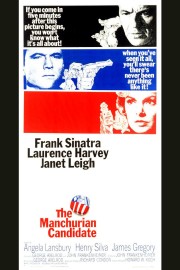
The movie begins in Korea. The year is 1952. The Korean War has brought American soldiers over. Staff Sergeant Raymond Shaw (Laurence Harvery, haunting and hypnotic), a straight-arrow soldier, has walked into a Korean brothel to get his soldiers out into the field. Not long after, Shaw and his company are ambushed and taken hostage. Cut to a short time later. Shaw is flown to Washington, having earned the Congressional Medal of Honor for his bravery in saving the remaining soldiers in his company. His mother (Angela Lansbury) and her new husband, congressman Johnny Iselin (James Gregory, engagingly over-the-top), are there to take advantage of the hero’s welcome for Iselin’s political campaign. Immediately we see that Shaw has no love for either his mother of Senator Iselin.
So begins “The Manchurian Candidate,” John Frankenheimer’s brilliant political thriller that rates with Kubrick’s “Dr. Strangelove” as the most exemplary Cold War satire in film history. The film is based on the novel by Richard Condon and is a note-perfect examination on the McCarthyism that took hold in 1950s American and the paranoia that has resonated all the way to the modern era, where conspiracy theories about everything from the Kennedy assassination to Watergate to 9/11 to even the birthplace of our current President have become a typical part of the political landscape in this country. This makes Frankenheimer’s film as timely and lively as ever; Jonathan Demme put his own spin on the material in 2004, but that film lacks the bite and excitement of the original.
Never is this more true than in Lansbury’s Mrs. Iselin, who followers of modern politics will no doubt see as an early template for Karl Rove in the way she manipulates not only her husband but uses Raymond’s “heroism” for political leverage for her husband’s campaign, and is not afraid of bringing out trigger words like “communist” in describing her enemies. I put heroism in quotations because questions begin to arise for the audience when we see Major Bennett Marco (Frank Sinatra, who was never more riveting on-screen) have the same nightmare, with the platoon in a room full of military brass as an Asian doctor– who has brainwashed the platoon to think they’re at a women’s garden club –gets Shaw to assassinate two members of his platoon. We see Marco recite a cover story that will, upon their return to the States, become the truth in the government’s “spin” of the events. As the film moves along, we will see how these nightmares effect not only Marco but others from Shaw’s company, and will go deeper down the rabbit’s hole as Marco (who has been put on leave by the military) tries to get to the truth of what happened, and try to de-program Shaw himself after he finds out that the Queen of Diamonds is Raymond’s “trigger card.” Frankenheimer and writer George Axelrod reveal things slyly, peeling off layer after layer patiently even as the film’s innovative visual style moves at a breakneck pace. Frankenheimer worked in television through much of his career, and his best films (which also included the underappreciated “Seconds” and “Ronin”) showed how that brisk-moving style was a plus to his films.
The most lasting part of “Candidate” is its political intelligence. No one affiliation is attacked in this film– just politics in general. The way the media is used to create a narrative about what happens in battle. The abuse of American trust that leads to witch hunts like the one Iselin– who never really says the same number for how many Communists are in the Defense Department –drives into the public consciousness. Political manipulators like Shaw’s mother (played by Lansbury in one of the greatest and most devilish performances in film history) who are at the heart of such toxic political environments. And of course people who trust too much in our political institutions. I’m not saying our government has secret sleeper assassins it conditions for political killings, but I’d be foolish to think the government isn’t capable of doing so.


